Article originally posted on Labor South:
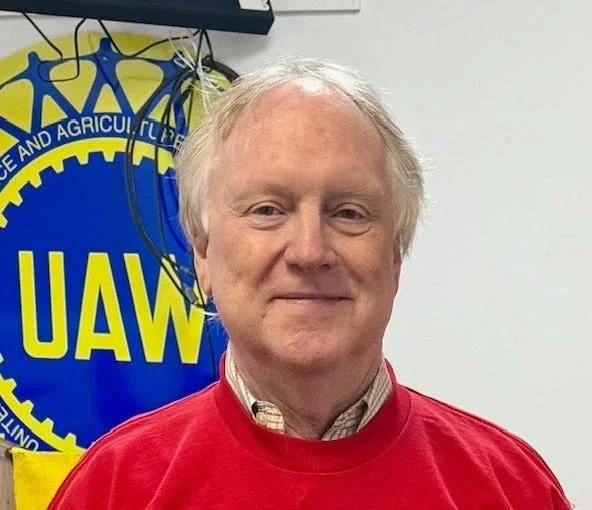
Robert “Bob” Korstad: A Life Rooted in Labor
Robert “Bob” Korstad has been surprised by the renewed interest from union leaders and workers in his 2003 book, “Civil Rights Unionism,” which details tobacco worker organizing in Winston-Salem in the 1940s. His work even inspired a 32-song opera, “Love Songs from the Liberation Wars,” and a short documentary film about the Winston-Salem sit-down strike.
As a member of Labor South’s advisory committee, Korstad has long championed movements for racial and economic justice in the South. Although officially retired, he now volunteers nearly full-time with Labor South, energized by a resurgent interest in labor history driven by a recent increase in Southern labor organizing.
Korstad, professor emeritus of public policy and history at Duke University, received his B.A. and Ph.D. from the University of North Carolina at Chapel Hill. Throughout his career, his research has spanned 20th-century U.S. history, labor history, African American history, and contemporary social policy.
A Legacy of Resistance
Union organizing is central to Korstad’s family history. His parents met in Charleston, South Carolina, during World War II. In 1945, they supported a major strike by the Food, Tobacco, Agricultural, and Allied Workers-Congress of Industrial Organizations (FTA-CIO), writing leaflets and organizing an integrated lecture series on the “New South.”
After the war, the FTA-CIO promoted his father to southeast regional director, prompting a move to the Chapel Hill-Carrboro area, where Korstad was born on November 14, 1948. At the time, the FTA-CIO was known as one of the left-led unions within the progressive CIO, as many of its leaders were members of or associated with the Communist Party.
The Crown Jewel of Winston-Salem
In early 1949, the family relocated to Winston-Salem because the FTA-CIO’s “crown jewel” was located there: Local 22. The Local 22 held the bargaining rights for 12,000 R.J. Reynolds Tobacco Co. employees. “They also had another 10,000 employees in eastern North Carolina under contract,” Korstad said. “So, they wanted [my father] to be close to where the action was. The fact they had organized Reynolds in the 1940s in the South was pretty remarkable—it was a very anti-union place.”
This union, which Korstad documented in “Civil Rights Unionism,” provided the blueprint for Southern organizing. The organizers at R.J. Reynolds included a large number of Black women working in the stemming departments. Local 22 “initiated and sustained a broad-based challenge to economic exploitation, political disenfranchisement, and racial discrimination in Winston-Salem, N.C.” [from “Civil Rights Unionism.”]
The Cold War Crackdown
Despite its successes, Local 22 lasted less than a decade, succumbing to political forces such as the Taft-Hartley Act of 1947, which restricted union activities and required leaders to sign non-communist affidavits. In 1950, the CIO purged left-leaning unions, including the FTA. Stripped of national support and facing a massive anti-union campaign by R.J. Reynolds, Local 22 lost a narrow recertification election in 1950, ending its legal status.
“So, my parents had to decide what to do after my father lost the union job,” Korstad recalled. “My father got offered a union job in New York, but he and my mother decided that they wanted to stay in the South and do what they could to help things along here.”
To make ends meet, his parents opened a landscape nursery and garden center on a “little road in Greensboro.” Despite living in a segregated area, the family maintained friendships with African American friends and labor activists.
Childhood Lessons
“Probably five or six years after he started the business, one of the key leaders in the union in Winston-Salem, a Black man named Robert ‘Chick’ Black, came to work with my father. “Every time [Chick] got a job somewhere, the FBI would come and start asking questions—and then he’d be fired, so he came and started working with my father.”
“I learned a lot from [Chick],” Korstad recalled. “I had my first kind of comeuppance as a white boy with Chick. This was probably around 1966, when Greensboro got its first McDonald’s. I would work with Chick doing landscaping jobs—he would drive the truck, and we’d go do jobs together.
“So, this one particular day, we hadn’t brought our lunch, and I wanted to go to this new McDonald’s. Chick said okay. And so we pulled in and I got out of the truck and asked him, ‘Aren’t you coming in?’ He said, ‘Well, no, I’m not. Here’s some money—get me this.’
“I asked him why, and he told me, ‘Well, they won’t serve me here.’
“And you know, I just shrunk—I was so embarrassed. I had put him in this position. The world out there was different from the world my parents were trying to raise me in. I just didn’t think about it. And I was incredibly embarrassed.”
The Personal Cost of Politics
In 1958, the House Committee on Un-American Activities (HUAC) held another round of congressional hearings throughout the South. During one of the Atlanta hearings, his father and a few other FTA-CIO workers were called to testify. “They all took the Fifth Amendment... but it was reported in the Greensboro paper with a big picture of my father.”
Luckily, Korstad’s father didn’t lose much business from the reporting, though there were other repercussions. “I didn’t get to be in the Cub Scouts,” he chuckled. “There was at least one parent who didn’t want their kid in Cub Scouts with a Commie. I would have been a bad Cub Scout anyway, so it was all good.”
When he was a teen, Korstad said the family was excluded from a new swim club, even though his father had initially been pressured by other parents to join. “My father had to come home—and I remember this like it was yesterday—to tell my brother and me that we weren’t going to join after all. I remember we were sitting out in our side yard at a picnic table, and it was the first time he ever really spoke directly about the impact of the union years.”
A Political Awakening
In his senior year of high school, Korstad experienced a political turning point. His debate team participated in a national competition focusing on foreign aid and policy. Korstad and a friend built “an affirmative case for the United States’ intervention in Vietnam for foreign aid, not troops,” arguing for the support of the North Vietnamese as “true nationalists” and liberals.
“We were really good,” he reminisced. “We won every tournament, even against the ‘fancy’ high schools in North Carolina.” At the regional competition in Stokes County, however, they hit a wall. “The judges were horrified by our case,” he said. “I’ll never forget our teacher screaming at the judges, and she dragged us out of there. For me, that was a very educational experience. I learned that people were not going to be persuaded by arguments.”
Primed for political engagement by both his debate experience and family roots, he enrolled at UNC-Chapel Hill in the fall of 1967. “Coming from a rural area, it took me about a year or so to figure out how to be a student,” he said.
In 1968, a strike by the mostly Black workforce at UNC, which escalated when the governor brought in the National Guard, drew Korstad into campus activism and solidified his interest in political science. He joined the New University Conference (NUC), a self-identified socialist group for graduate students and faculty that organized conferences, protested at Fort Bragg, and built alliances with anti-war GIs and the Black Panther Party.
Two Numbers from Vietnam
After graduating in 1971, Korstad drew a relatively low number—127—in the Vietnam War draft lottery, which signaled a high probability of induction. Because of his poor eyesight and previous cataract surgery, he believed he would get a medical disqualification. His doctor assured him, “They’ll never take you... You could actually kill yourself and your fellow soldiers besides.”
Due to the military’s urgent need for replacements, he was passed anyway. “You know, a year ago we wouldn’t have, but we have a lot of people dying over there. This is the new standard,” the Army official told him.
In a last-ditch effort to avoid service, he admitted his affiliations with anti-war groups on an induction form. Instead of a disqualification, this led to an overnight security interrogation during which he refused to name associates. He was eventually classified as 1-A, but thankfully, his home county’s draft board stopped at number 125—he escaped the draft by two numbers.
History as a Tool for Change
After the lottery, Korstad moved to the Boston area for a few years and then to New York to attend the New School for Social Research to study economics. He balanced a challenging curriculum—reading foundational texts from Adam Smith to Karl Marx—with a full-time job and involvement in the Union for Radical Political Economics (URPE). He felt “in over his head” with the new material but paid his own way through with loans and work.
After two years, he moved back to Boston to complete his master’s thesis remotely. His research focused on the Food and Tobacco Workers (FTA-CIO) union history in Winston-Salem. “It was at this time that I first started doing the research that led me to write my book,” he said. “I realized that I was sitting on the most amazing story.”
He eventually secured a six-month fellowship in the history department at Duke University, where he met Bill Chafe. The respected professor convinced him that he was never going to be able to write the book he wanted without a Ph.D. In 1981, he pursued his Ph.D. at UNC.
“It was perfect,” he said. At the Southern Oral History Program—founded by his future wife, Jacqueline Dowd Hall—Korstad helped to write the landmark book “Like a Family: The Making of a Southern Cotton Mill World.”
“We Don’t Write History—We Make It”
After earning his Ph.D. in 1987, Korstad’s goal was to use labor history as an organizing tool. He sent a job proposal to 25 unions but found they preferred technical researchers for wage negotiations. A union representative famously rejected his idea: “We don’t write history—we make history.”
Because of these rejections, Korstad chose a career in academia, eventually landing a position at Duke’s Sanford School of Public Policy. He has remained there for 33 years. At Duke, he finished “Civil Rights Unionism.” He said the book was a long time coming. “The first half I wrote as a dissertation,” he said. “But then I realized I needed to understand what came before that: What was it about the politics of Winston-Salem, of Reynolds Tobacco Company, the culture of African-American workers in Winston-Salem? That was harder research to do, but eventually I published the book in 2003.”
Organizing the New South
Korstad firmly believes that understanding local labor and community history is a crucial, yet overlooked, tool for union organizing in the South. He attributes the South’s low unionization rates to several factors:
Political and Legal Repression: The use of the National Guard, anti-union laws like right-to-work, and North Carolina’s prohibition on collective bargaining for public employees have suppressed union activity.
Anti-Union Propaganda: Portraying Southern workers as individualistic and using racial divisions to frame unions as communist.
Cultural Stereotypes: A narrative that Southern culture is pessimistic and fatalistic.
Lack of Historical Awareness: A widespread lack of knowledge about the South’s rich labor history.
“There’s been a tremendous amount of economic change in the South,” Korstad said. “Now we look more like the Midwest or the North in terms of factories and the kinds of issues that workers face. I think the end of racial segregation and the racial hierarchies within the workplace have changed a lot in the last 30 years or so.”
Korstad says that a combination of national unions’ interest in organizing the South and working conditions for Southern workers is leading to more interest in unionization. Currently, African American workers are a strong base for union support, while Latino workers have also proven supportive in organizing campaigns. White workers remain the most challenging group to organize, Korstad laments. “Historically, if there’s a plant that’s 50% African American, your chance of union organizing is much greater than if it’s 20%.”
A real opening for organization is emerging in the South, extending beyond traditional factory unions to include community-based issues like housing and environmental justice. This multifaceted approach is supported by a new ecosystem of progressive organizations like the Carolina Federation and Siembra NC.
“I think something is happening in the South,” Korstad said. “Historically, small towns’ distance between the local elites and the working class was much greater than it was in the North. For example, in Winston-Salem in the 40s, none of the middle-class groups had the wherewithal or the courage to support the workers in their fight against Reynolds. And that was mostly true of the Black middle class too. You didn’t have any of these kinds of liberal groups that we are seeing today.”
Today, Korstad still believes the labor movement is a critical force for changing the country’s direction. He highlights Labor South’s institutional work integrating research, teaching, and outreach as “long overdue.”
Investing in the Next Generation
Korstad sees his work at Duke and with Labor South as a lifelong mission to help younger people better understand the complexities of society’s inequalities. Through various civic engagement projects he created, he sought to provide students with a real-world education far removed from the classroom. He remains a realist about the pull of the corporate world, though. “It’s not always successful,” he chuckled. “I find some of these kids who I thought were going to do great things in the world working for Microsoft. Where did I go wrong?”
Yet, those exceptions only underscore the necessity of the work—and Korstad is far from cynical. He sees a new, vibrant wave of organizing emerging—one that extends beyond traditional union halls to tackle housing, environmental justice, and local politics. Backed by a growing ecosystem of progressive groups, he remains convinced that the labor movement is one of the most critical drivers in changing the country’s direction. For Korstad, the goal of Labor South is to ensure the next generation of working-class leaders has the historical tools to finish what his parents and the organizers of Local 22 started. He isn’t just helping to record history—he’s helping to build the training programs that will empower a new generation to write the South’s next chapter.